David Clift
FirstEDA





David Clift
FirstEDA
Every FPGA designer has been there. The design passes simulation, the testbench is green, the bitstream builds. Then on the bench it’s all over the place. It behaves completely intermittently and never the same way twice. Days later, with an ILA attached and the schedule becoming absolutely pear-shaped, you’ve got the root cause down to a single line of code. It’s probably an incomplete if statement that has ended up as a latch, or a signal crossing between clock domains with no synchroniser.
Neither bug is exotic, and both could have been picked up the moment the code was typed. That’s the case for HDL coding guidelines backed with automated checking.
HDL is not software
Software coding standards are primarily about readability. HDL coding standards do that, but they also serve to protect something even more important: the mapping from the HDL you write to the actual logic gates you end up with.
Three things make HDL different:
Here is the classic example. This VHDL simulates exactly as the designer expects:
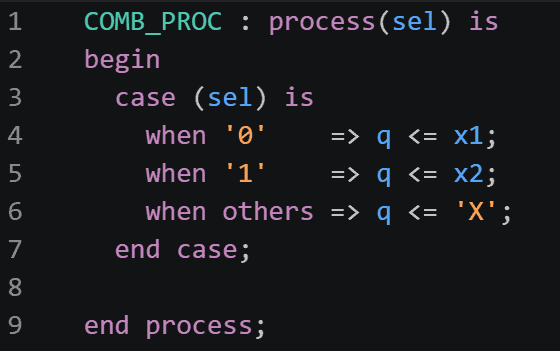
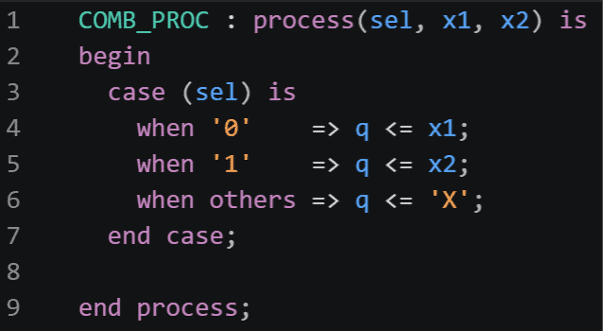
In simulation, q is not updated when either x1 or x2 changes, i.e. it behaves like a latch. Synthesis ignores the sensitivity list, so q updates when either x1 or x2 changes; it behaves as a combinational circuit with no stored state. A simple guideline prevents it:
In every combinational process, include every signal read within the process in the sensitivity list.
“It’s an FPGA, we can just reprogram it”
Reprogrammability is one of the FPGA’s great strengths, but it has not made bugs go away. In the 2024 Siemens EDA / Wilson Research Group FPGA Functional Verification Trend Report, 87% of FPGA projects reported non-trivial bug escapes into production. That means only 13% shipped clean.
The cost of a bug rises sharply the later you find it. In the editor, it costs minutes; in simulation, hours. In the lab, with scopes and logic analysers, it costs days. In the field, it means updates, support calls and lost reputation. In aerospace, defence, automotive and medical products, changing a fielded bitstream can also mean re-qualification.
Coding guidelines are the cheapest layer of defence because they work at the very start of that curve. They eliminate whole classes of bugs before a single test is run.
What guidelines actually prevent
Most guideline rules exist because a specific, recurring failure has burned someone before. The usual suspects:
=) in clocked Verilog blocks, where non-blocking (<=) belongs
Beyond correctness
Guidelines aren’t only about preventing bugs. FPGA code routinely outlives its authors, and in industrial, defence and space products a design may need to be maintained for 10 to 30 years and beyond. Consistent naming, file structure and parameterisation mean any engineer, contractor or customer can pick up a module and understand it quickly.
They also make code reviews better. When formatting and basic rules are settled and checked automatically, with tools like Aldec ALINT-PRO or Sigasi Visual HDL. Reviewers stop debating indentation and spend their time on architecture and purpose. Blocks written to a common standard drop into the next project without rework, which is where design reuse actually pays off.
Compliance: often required
In regulated markets, coding guidelines are expected. For airborne hardware, FAA Order 8110.105A requires applicants to define HDL coding standards consistent with their system safety objectives and to demonstrate conformance through code reviews. ISO 26262-11 applies automotive functional safety to semiconductors, explicitly including FPGAs. ESA requires its VHDL modelling guidelines to serve as the baseline for new IP, with any exceptions documented.
Even if you never certify a design, these standards record what safety-critical industries learned the hard way. They are an excellent starting point for your own rules.
Making guidelines stick: automate them
“A guideline that nobody checks is just a document on the wiki”
Guidelines work when tools check them automatically, at the right points in the flow.
As you type, with Sigasi Visual HDL. Sigasi brings guideline checking into the editor. It analyses VHDL, Verilog and SystemVerilog as you type and flags incomplete sensitivity lists, naming violations, unused signals and style issues while the code is still on screen. That is the cheapest possible point to fix a problem. Its built-in formatter applies the team’s layout rules automatically, which ends formatting debates for good. Because its diagnostics are deterministic, the same checks can run in CI through the Sigasi CLI, giving the team what Sigasi calls an “upstream RTL quality gate” that “can reduce the number of bugs that ever make it to debugging”.
Design-wide sign-off, with Aldec ALINT-PRO. ALINT-PRO provides in-depth static design verification across the whole design. Its rule categories cover coding style, readability, simulation, clock and reset management, design reuse, safe synthesis and implementation. It also contains dedicated CDC and RDC analysis. ALINT-PRO offers ready-made rule sets based on industry standards, including DO-254, so teams don’t have to write a guideline from scratch. It produces the reports and documented waivers that certification audits need.
The two tools complement each other. Sigasi catches issues as each engineer writes code. ALINT-PRO checks the integrated design against the full rule set before release. Peer review, with lint reports attached, then focuses on what only humans can judge.
A few helpful hints for rolling guidelines out:
This matters more than ever as teams bring in third-party IP and AI-generated RTL. Automated guideline checks apply the same standard to every line of code, regardless of who or what wrote it.
The bottom line
HDL coding guidelines turn tribal knowledge into checkable rules. They prevent the bugs that simulation misses and that the lab finds expensively. They make designs readable, reusable and certifiable. With Sigasi in the editor and ALINT-PRO for design-wide sign-off, enforcing them costs seconds, not days.
The cheapest bug is the one flagged as you type.
Want to see how Sigasi Visual HDL and Aldec ALINT-PRO could work on your own designs? Contact the FirstEDA team to arrange a demonstration or an evaluation licence and run them on your own designs.